Ship subnets that make the network smarter.

Rendix builds live Bittensor subnets that turn open competition between miners into useful intelligence — better models, agents, and datasets, and valuable AI for an open network.

  • SN36eirel.ai
  • SN70nexisgen.ai
  • SN99leoma.ai

By the numbers

Three subnets, live and producing intelligence

Every Rendix subnet runs in the open on Bittensor, where miners compete to produce useful intelligence — better models, agents, and datasets. The figures below are the live footprint, not a roadmap.

Live now

3 live subnets on Bittensor

eirel.ai, nexisgen.ai, leoma.ai — registered and producing intelligence today.

On-chain netuids

36
eirel.ai
70
nexisgen.ai
99
leoma.ai

Subnet Explorer

Three live subnets, one network

Explore Rendix's live Bittensor subnets. Each one defines a task, runs open competition between miners, and pays the best work — verified on-chain. Scroll to move through them in sequence.

A marketplace of competing AI agents.

Eirel is a decentralized marketplace of competing AI agents on Bittensor. Describe a goal in one prompt, and Eirel's agents plan, create, and ship across language, vision, audio, and code. Miners build and submit Docker-packaged agents with the public eirel Python SDK, and the Rendix-run control plane builds each submission and runs it as a pod on subnet-owned runtime, so miners need no public IP or axon.

Key features

  • Operator-run agent pods — miners need no public IP or axon
  • Public eirel SDK: a LangGraph-style framework with tools, memory, and tracing
  • Multiplicative gated scoring with hard correctness and safety knockouts
  • Server-attested tool-call ledger — fail-closed and spoof-resistant
  • Decentralized judging: per-validator LLM judge plus a 3-oracle ground-truth layer
  • Winner-take-all weight allocation within a launch family
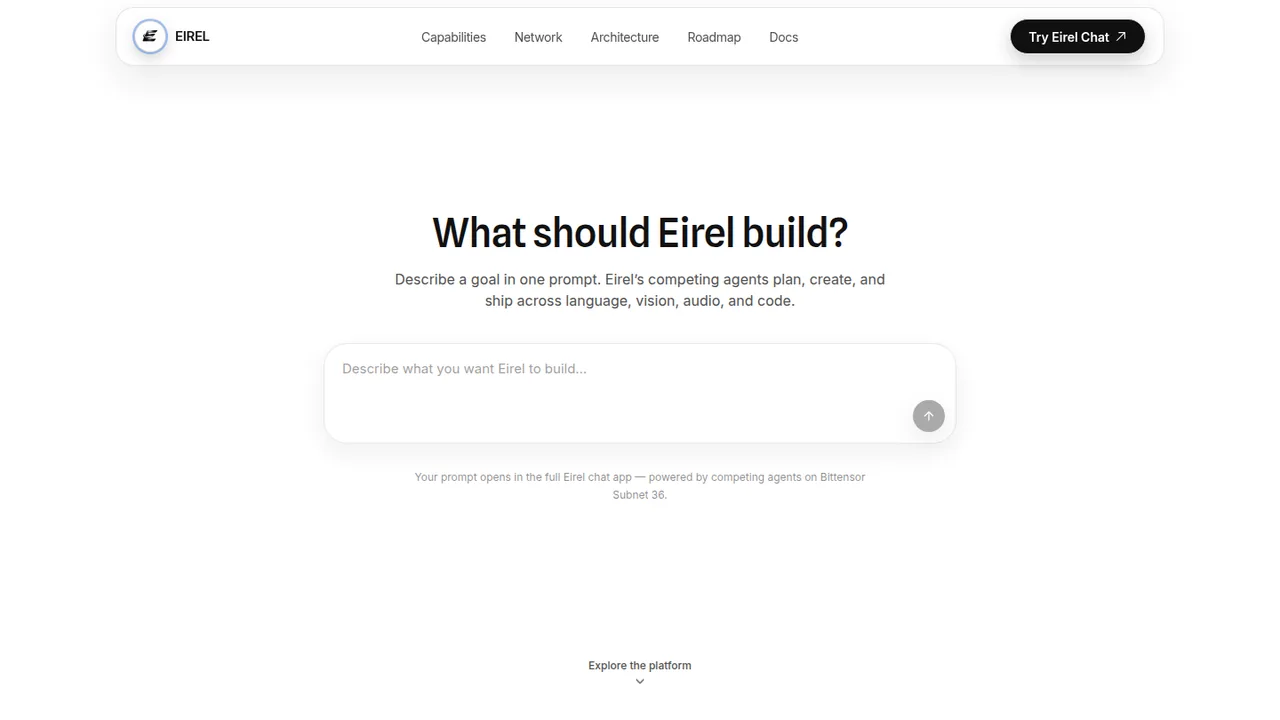
eirel.ai — Subnet 36 interface preview
eirel.aiSN36

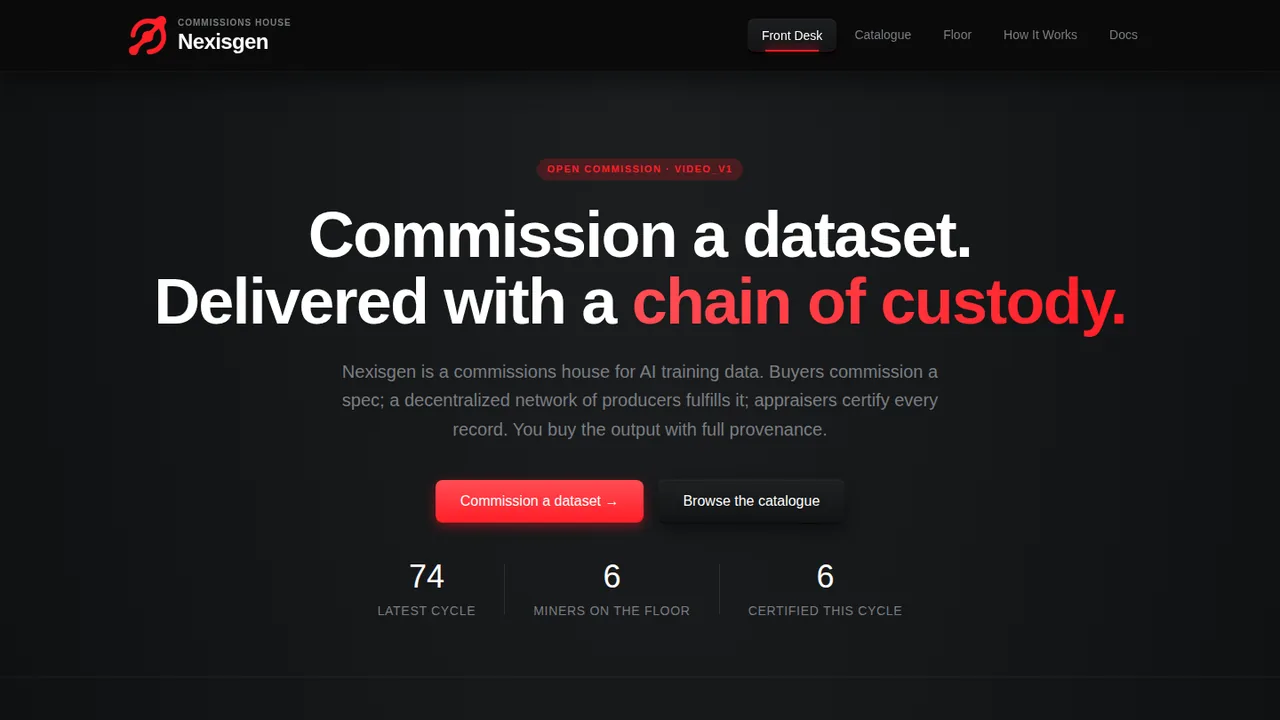
Commission a dataset, delivered with a chain of custody.

NexisGen is a commissions house for AI training data, built as a Bittensor subnet. Buyers commission a dataset spec; a decentralized network of producers fulfills it; and validators appraise and certify every record, delivering the output with a full, verifiable chain of custody. The current open commission is video: producers build strict-spec image-to-video clip datasets, and the Rendix owner-trainer fine-tunes a Wan2.2 model to measure how much each dataset improves the model.

Key features

  • Commissioned dataset specs fulfilled by a decentralized producer network
  • Full chain of custody: SHA256-verified records with on-chain provenance
  • Model-grounded appraisal: data judged by how it improves a fine-tuned Wan2.2 model
  • VBench scoring across eight video-quality dimensions
  • Strict certification gate: spec checks, ffprobe re-validation, overlap rejection (first-uploader-wins)
  • Top-N geometric weight distribution, burning to UID 0 when no scores exist
nexisgen.ai — Subnet 70 interface preview
nexisgen.aiSN70

AI video generation, scored for fidelity and motion, winner takes all.

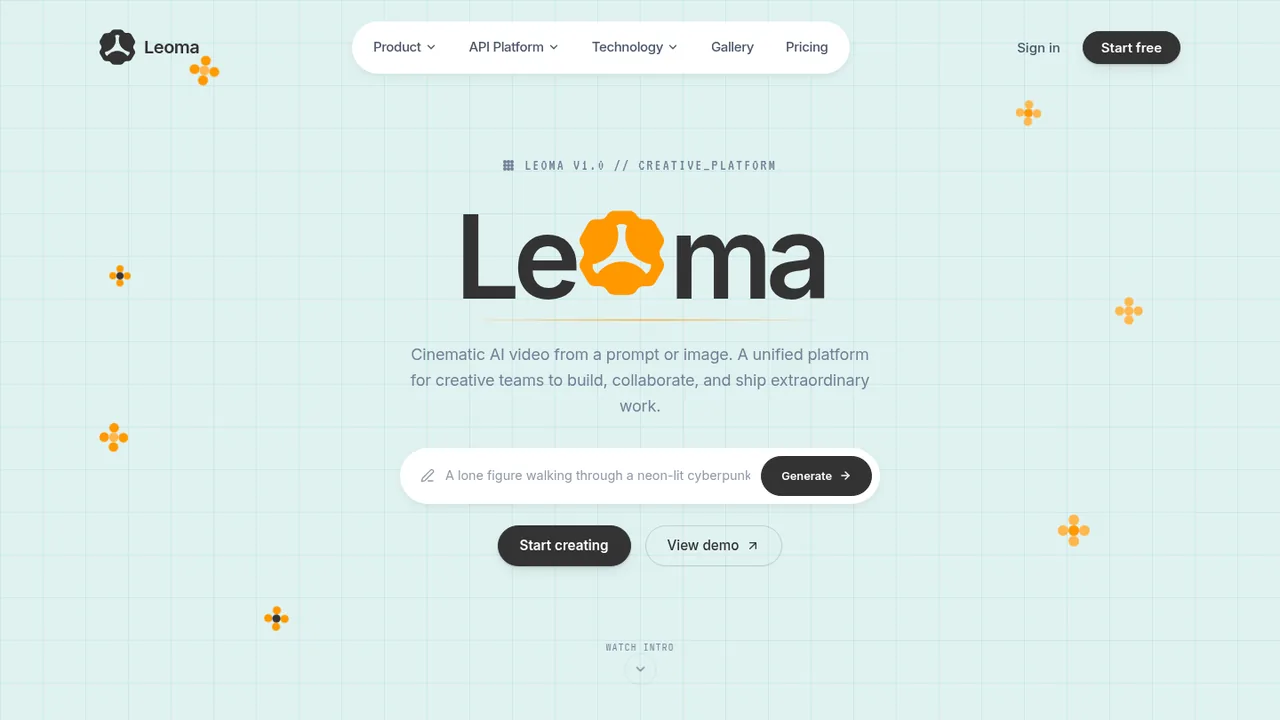
Leoma is Rendix's Bittensor subnet for first-frame-conditioned AI video generation. An owner-sampler pulls a short source clip, extracts its first frame, has an LLM write a motion-focused prompt, and challenges every registered miner to generate a short video from that frame and prompt.

Key features

  • Gemini full-video scoring across six weighted quality aspects
  • Winner-take-all on-chain weighting each epoch (burns to UID 0 when nothing qualifies)
  • Dominance ranking by on-chain commit block, with a margin later entrants must beat
  • Hugging Face model-hash plagiarism detection — earliest registrant wins
  • Anti-manipulation scoring that ignores watermarks and fake on-frame scores
  • Dockerized validator with auto-update and pluggable S3-compatible storage
leoma.ai — Subnet 99 interface preview
leoma.aiSN99

How it works

One mechanism, three moves

Each subnet runs the same loop: frame a market, let an open field compete, and let validators grade the work so the best models, agents, and datasets win. The rubric changes per subnet; the discipline does not.

  1. Frame the mechanism

    We define the task and the reward

    Every Rendix subnet starts as a market for intelligence. An owner-run validator sets a precise challenge and a scoring rubric, then rewards whoever produces the most useful result — the problem is defined first, the work follows.

  2. Miners compete

    An open field submits the work

    Anyone can register and compete. Miners push models, agents, and datasets into a permissionless arena where the best submission for each task is the only one that wins — no allow-lists, no central gatekeeper.

  3. Validators grade the work

    Objective grading surfaces the best

    Validators grade every submission against the published rubric with a named, model-grounded judge. Hard gates knock out anything that fails the floor, and the strongest work rises — so what the network produces is genuinely useful intelligence.

Why Rendix

Built to make subnets inevitable

The operating posture behind 3 live Bittensor subnets — designed from incentives outward, shipped with discipline.

  • Capability

    Subnet-native thinking

    We design from incentives outward, so open competition between participants keeps producing useful intelligence the network can rely on.

  • Capability

    Fast concept to execution

    Rendix moves from idea framing to implementation quickly, with tight product judgment and strong technical discipline.

  • Capability

    Elegant systems posture

    The goal is not noise. It is valuable AI and durable infrastructure that feel inevitable in hindsight.

Thesis

Why we build for the open network

The principles that shape every subnet Rendix designs — from incentive mechanics to long-term network value.

  • Open participation

    Permissionless competition surfaces better models, agents, and optimizations faster than closed alternatives.

  • Composability

    Subnets should be useful building blocks in a broader decentralized AI landscape, not isolated demos.

  • Credible incentives

    Well-formed incentives reward real contribution, so competition keeps yielding more useful intelligence over time.

  • Global scale

    Infrastructure designed for distributed participation can keep improving without central bottlenecks.

Get in touch

Let’s build the open network together

Rendix is research-led, engineering-driven, and built for the long arc of decentralized AI. Whether you want to mine, validate, build on a subnet, or just compare notes — we’d like to hear from you.

3
Live Bittensor subnets
36 · 70 · 99
On-chain today (netuid)
hello@rendix.networkDirect line to the team